
Marketing ROI is a simple idea with a lot of complexity behind it. At a high level, it measures how much revenue your marketing generates compared to what you spend. But in practice, calculating marketing ROI accurately depends on how well you track conversions, assign credit across channels, and separate marketing impact from everything else affecting revenue.
That is why marketing ROI is one of the most discussed metrics in growth, performance marketing, and attribution reporting. It sounds straightforward, but the quality of the answer depends on the quality of your measurement. For teams trying to connect spend, channels, and revenue more clearly, a dedicated marketing attribution platform can make that process more reliable.
What is marketing ROI?
Marketing ROI, or return on investment, is the measure of revenue or profit generated from marketing relative to the cost of that marketing. It helps teams understand whether campaigns, channels, and programs are delivering financial value.
The most common formula is:
Marketing ROI = (Revenue from marketing – Marketing cost) / Marketing cost x 100
For example, if you spend $10,000 on marketing and generate $30,000 in revenue attributed to those efforts, your marketing ROI is 200%.
That means you earned twice your investment back, beyond recovering the original spend.
This is where marketing ROI often overlaps with other metrics like ROAS. They are related, but they are not the same. ROAS focuses on revenue generated from ad spend. Marketing ROI is broader. It can include paid media, content, lifecycle marketing, events, software costs, agency fees, and internal resources depending on how your organization defines marketing investment.
Why marketing ROI matters
Marketing ROI matters because it connects activity to business outcomes. Traffic, clicks, and leads are useful indicators, but they do not tell leadership whether marketing is creating efficient growth. ROI gives teams a more strategic way to evaluate performance.
It also helps with budget decisions. If one channel produces strong pipeline but low short term ROAS, while another delivers efficient direct conversions, ROI analysis helps you compare them in context instead of judging everything through one narrow lens.
For demand generation and ecommerce teams alike, this becomes especially important when budgets tighten. It is much easier to defend spend when you can show not just volume, but return.
How to calculate marketing ROI
There is no single perfect formula for every business, but the core approach is consistent. You need three things: marketing cost, attributed revenue, and a clear definition of what counts as return.
Basic marketing ROI formula
The standard version looks like this:
Marketing ROI = (Attributed revenue – marketing investment) / marketing investment x 100
If a campaign produced $50,000 in attributed revenue and cost $20,000 to run, the math would be:
($50,000 – $20,000) / $20,000 x 100 = 150%
This means the campaign returned 150% above its cost.
What should be included in marketing cost?
This is where teams often create inconsistent ROI reporting. Some include only ad spend. Others include creative production, software, contractors, agency retainers, and salaries. None of these are automatically wrong, but they produce very different answers.
At minimum, your method should be consistent. If you compare channels or time periods using different cost definitions, the resulting ROI numbers will be misleading.
A practical breakdown may include:
- Media spend
- Agency or freelancer costs
- Creative and production costs
- Marketing tools and platform fees
- Event or sponsorship costs
- Allocated team costs where relevant
For broader strategic reporting, this fuller view is usually more useful than looking only at ad spend.
What counts as return?
Return is usually attributed revenue, but even that needs definition. In ecommerce, this may be relatively direct. In B2B, it can be much harder because sales cycles are longer, multiple stakeholders are involved, and revenue may close months after the first touchpoint.
Some teams measure ROI on closed revenue only. Others use pipeline value, qualified opportunities, or projected revenue as interim signals. Closed revenue is more rigorous, but slower. Pipeline based ROI is faster, but more directional.
The key is to label the metric clearly. Pipeline ROI and closed revenue ROI should never be treated as interchangeable.
Marketing ROI vs ROAS
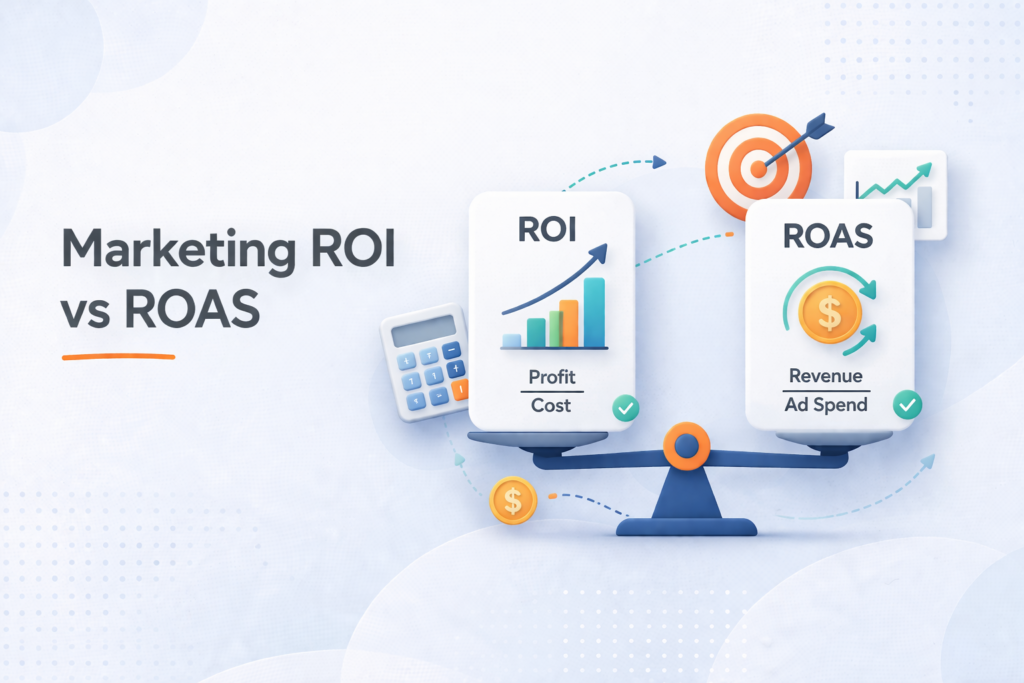
ROAS and marketing ROI are often confused because both relate revenue to spend. The difference is scope.
| Metric | What it measures | Best used for |
|---|---|---|
| ROAS | Revenue generated from ad spend | Evaluating paid campaign efficiency |
| Marketing ROI | Return after marketing costs are considered | Evaluating broader marketing profitability |
ROAS is especially useful for channel managers optimizing paid search, paid social, or shopping campaigns. But it can overstate performance if it ignores non media costs and over credits the final click.
Marketing ROI gives a broader business view. It is usually better suited for leadership reporting, budget planning, and comparing different marketing investments.
What affects marketing ROI?
Marketing ROI is not driven by spend alone. It is shaped by multiple factors across strategy, execution, and measurement.
Attribution model choice
Attribution model choice has a major impact on reported ROI. Last click may overvalue bottom of funnel channels. First click may overvalue acquisition. Multi touch models can give a more balanced picture, but they also require more mature tracking.
This is one reason marketing attribution is essential to ROI analysis. If credit assignment is flawed, your ROI calculation may look precise while still pointing you toward the wrong decisions.
Conversion tracking quality
Broken tracking creates false confidence. Missing UTMs, duplicate conversions, disconnected CRM data, and poor cross device visibility can all distort ROI reporting.
A campaign may look inefficient simply because conversions are undercounted. Another may look profitable because revenue is being over assigned to one touchpoint. Good attribution reporting depends on clean conversion tracking before anything else.
Sales cycle length
Longer sales cycles make ROI harder to measure in real time. This is especially common in B2B, where a campaign may influence awareness today but not produce closed revenue for several months.
In these cases, reporting only on immediate return can undervalue channels that create future demand. That is why many teams review both short term efficiency metrics and longer term revenue outcomes together.
Offer quality and conversion rate
Strong targeting cannot fix a weak offer or a poor landing page experience. Marketing ROI depends not just on getting traffic, but on converting the right audience efficiently.
If ad spend rises while conversion rate drops, ROI can fall quickly even when top line lead volume looks healthy. This is why creative, messaging, audience fit, and funnel design all matter.
Customer value
A campaign that acquires high retention customers may have better true ROI than one generating more first purchase revenue from lower value buyers. Looking only at immediate revenue can hide this.
In subscription businesses especially, customer lifetime value changes the picture. A channel with modest early returns may be highly profitable over time if it consistently brings in customers with strong retention and expansion potential.
Common mistakes when measuring marketing ROI
One common mistake is treating attribution as exact truth rather than directional measurement. No model is perfect, especially across multiple channels and devices. The goal is better decision making, not false precision.
Another mistake is focusing only on channel level return without looking at the full customer journey. Branded search might show excellent ROI, but much of that demand may have been created by upper funnel activity elsewhere.
Teams also make the mistake of reporting ROI without context. A 300% ROI may sound strong, but if the channel has limited scale, it may not materially affect growth. On the other hand, a lower ROI channel may still deserve investment if it drives strategic pipeline volume.
How to improve marketing ROI
Improving marketing ROI is not just about cutting spend. It is about allocating spend more effectively and improving the system around it.
Start by tightening tracking. Clean campaign naming, reliable conversion capture, CRM integration, and de duplication all improve the quality of your reporting. Then review your attribution approach so you are not making budget decisions based only on the last touch.
From there, focus on the biggest leverage points: audience quality, offer strength, landing page conversion rate, sales follow up, and channel mix. In many cases, small improvements in these areas have a bigger effect on ROI than reducing bids or budgets.
It also helps to centralize your reporting. When paid media, CRM outcomes, and attribution data live in separate tools, ROI becomes harder to trust. Looking at Attributy’s features can help you see how a single platform brings together attribution, mix modeling, live tracking, and reporting, while its solutions show how different teams and industries apply that visibility to measure performance more clearly across the funnel.
Final thoughts
Marketing ROI is one of the most important metrics in modern marketing, but it is only as useful as the data and assumptions behind it. The formula itself is simple. The challenge is deciding what costs to include, how to measure return, and how to assign credit across the journey.
The teams that get the most value from marketing ROI do not treat it as a vanity metric. They use it as a framework for better decisions about spend, channel mix, and growth strategy. When supported by strong marketing attribution and reliable attribution reporting, ROI becomes much more than a finance metric. It becomes a practical tool for improving performance.