
Lead source attribution is the process of identifying where a lead originated and connecting that source to later outcomes such as qualification, pipeline, customers, and revenue. It helps marketers determine whether a channel is simply generating form submissions or creating leads that eventually produce business value.
A source that generates the most leads is not always the most valuable. One campaign may produce hundreds of inexpensive contacts that rarely progress, while another produces fewer leads with higher opportunity and close rates. Lead source attribution makes that difference visible by connecting acquisition data with the full revenue journey.
For B2B, SaaS, and sales-led companies, this requires more than adding a lead source field to the CRM. Reliable measurement depends on capturing the first interaction, preserving campaign data, tracking later touchpoints, defining lifecycle stages, and matching closed revenue back to marketing activity.
What Is Lead Source Attribution?
Lead source attribution identifies the channel, campaign, or interaction associated with a lead. Common lead sources include organic search, paid search, paid social, email, referrals, partners, events, direct traffic, and outbound activity.
It is a practical application of marketing attribution, focused specifically on how prospects enter a lead-generation process and what happens after they convert.
A basic CRM report may show only one value, such as “Google Ads” or “organic search.” That field can be useful, but it rarely explains the full journey. A buyer might discover a company through LinkedIn, return through an organic search, open an email, and finally submit a demo form after clicking a branded advertisement.
Good lead source attribution preserves the original source while also recording later interactions that help explain conversion and sales progression.
Why Lead Volume Is Not Enough
Lead volume measures activity, not quality. To understand channel performance, marketers need to know how leads progress after the initial conversion.
Consider two sources:
| Source | Leads | Opportunities | Closed revenue |
| Paid social | 180 | 8 | $20,000 |
| Organic search | 70 | 18 | $95,000 |
Paid social generated more than twice as many leads, but organic search produced more opportunities and substantially more revenue. A report focused only on cost per lead could lead the team to increase spend in the weaker source.
Lead source attribution connects acquisition metrics with CRM outcomes so teams can compare sources using qualification rates, pipeline, win rates, revenue, and customer value.
First-Touch, Lead-Creation, and Multi-Touch Attribution
Different attribution views answer different questions.
| Attribution view | Question answered |
| First touch | Where did the prospect first discover the business? |
| Lead creation | Which source produced the form submission or lead? |
| Opportunity creation | Which activity preceded entry into the sales pipeline? |
| Last touch | Which source appeared immediately before conversion? |
| Multi-touch | Which interactions contributed across the journey? |
First-touch attribution is useful for understanding demand creation. It shows which channels introduce new prospects, even when those prospects convert later through another source.
Lead-creation or last-touch reporting shows which campaigns are effective at turning existing interest into a measurable lead. However, it may overvalue branded search, retargeting, direct visits, and other interactions close to conversion.
Multi-touch attribution provides more context for longer buying journeys, but it also depends on stronger tracking and clear rules for assigning credit. The best view depends on the business question rather than one model being universally correct.
How to Track Leads from First Touch to Revenue
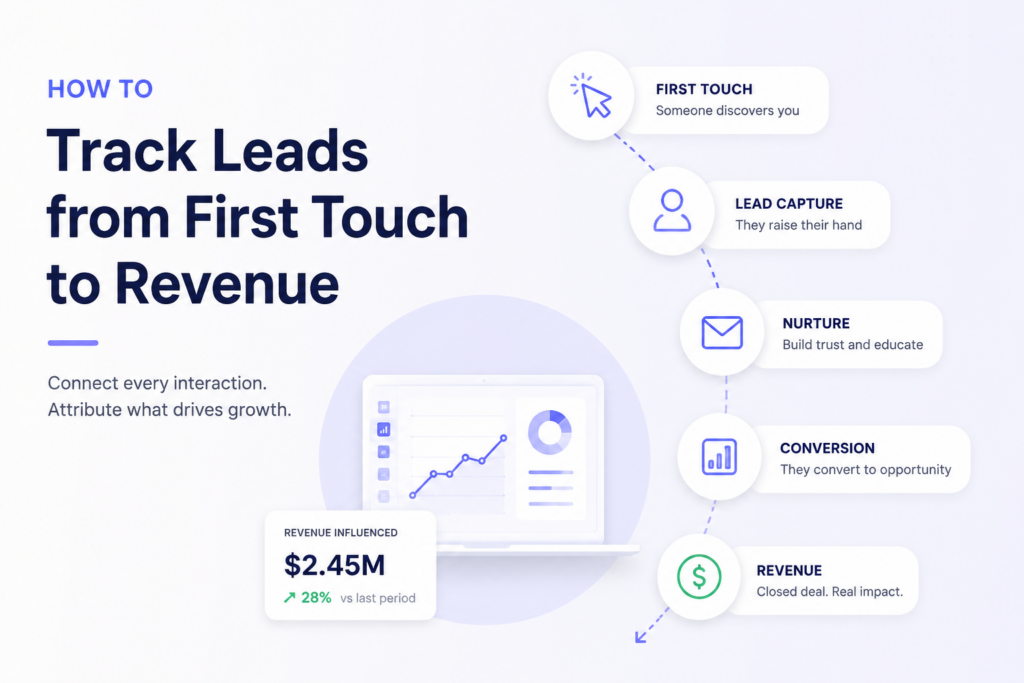
1. Define a Consistent Source Taxonomy
Start by deciding how sources and channels will be categorized. Without a shared taxonomy, CRM reports quickly fill with overlapping or inconsistent values.
For example, “Google,” “Google Ads,” “paid search,” and “PPC” might all refer to similar activity. At the same time, “demo request” describes a conversion type, not a source.
A clear structure separates different dimensions:
| Dimension | Example values |
| Source | Google, LinkedIn, partner name |
| Medium | CPC, paid social, email, referral |
| Campaign | smb_demo_q3 |
| Conversion type | Demo request, trial, purchase |
| Lead motion | Inbound, outbound, partner |
| Landing page | Product page or campaign page |
Source values should describe where the lead came from. Campaign, content, and conversion details should remain in their own fields.
2. Capture the Original Visit
The original source should be captured when the visitor first reaches the website, not only when the person submits a form.
Useful first-touch data may include source, medium, campaign, referrer, first landing page, and initial visit date. If this information is not stored early, it may be overwritten when the visitor returns through another channel.
UTM parameters are particularly important for paid media, email, partnerships, and other links the marketing team controls. A documented UTM governance system helps prevent campaign values from becoming fragmented across inconsistent naming variations.
Organic, referral, and direct traffic also require clear rules. Direct traffic should not automatically replace a known earlier source simply because a returning visitor typed the URL or used a bookmark.
3. Pass Attribution Data Through the Form
When the visitor converts, the captured source data needs to move into the form submission and CRM record. Hidden form fields are commonly used to send this information without requiring the user to enter it manually.
A practical form setup may include:
| Field | Purpose |
| Original source | Preserves the first known acquisition source |
| Original medium | Records the original channel type |
| Original campaign | Identifies the initial campaign |
| Latest source | Records the most recent known source |
| Latest campaign | Identifies the campaign connected to conversion |
| First landing page | Shows where the journey began |
| Conversion page | Shows where the lead was created |
Original source fields should usually remain unchanged after they are created. Latest-source fields can update when the lead returns through a new campaign.
This gives marketers two useful views: where demand began and which source converted the visitor into a lead.
4. Protect Attribution Fields in the CRM
Lead attribution often breaks after the data enters the CRM. Fields may be overwritten by sales representatives, replaced during record merges, or changed when a lead is converted into a contact or opportunity.
Define which fields can update and which should remain permanent. Original-source fields should generally be protected, while current-source or campaign-history fields may change as new interactions occur.
The CRM should also preserve marketing data when records move between objects. If a lead becomes a contact, account, or opportunity, the original source and campaign context should remain accessible.
A deeper CRM-to-marketing attribution implementation explains how marketing identifiers, offline outcomes, and revenue fields can be connected across the sales process.
5. Connect Sources to Lifecycle Stages
A source report becomes more useful when it shows how leads progress through the funnel.
Lifecycle stages may include:
| Stage | What it represents |
| Lead | A valid initial conversion |
| Marketing-qualified lead | A lead meeting marketing criteria |
| Sales-qualified lead | A lead accepted by sales |
| Opportunity | A potential deal with pipeline value |
| Customer | A completed purchase or closed deal |
The exact stages should match the company’s sales process. Marketing and sales must also agree on the definitions, otherwise qualification rates will not be comparable.
Connecting source data to lifecycle progression shows whether a channel produces real sales potential. It also reveals where performance breaks down. A source may create many qualified leads but few opportunities, indicating a handoff or targeting problem.
6. Match Closed Revenue Back to Marketing
The final step is tying customer revenue to the original source and relevant marketing interactions.
For B2B companies, this usually means connecting closed-won opportunity value with the contact, account, or lead records involved in the deal. Ecommerce and subscription businesses may connect transaction or recurring revenue directly to customer identifiers.
Revenue matching can become complicated when several contacts are associated with one account or opportunity. A decision-maker, product user, and finance contact may all interact with different campaigns before the deal closes.
The reporting rules should explain whether revenue is assigned to one primary contact, distributed across buying-group members, or connected at the account level. Consistency is more important than pretending there is one perfect method.
What Lead Source Attribution Reporting Should Include
A useful report follows source performance through the funnel instead of stopping at the number of leads.
| Metric | What it reveals |
| Leads by source | Initial acquisition volume |
| Qualified leads | Lead quality |
| Opportunities | Pipeline creation |
| Lead-to-opportunity rate | Source progression efficiency |
| Pipeline value | Potential commercial impact |
| Closed revenue | Confirmed financial contribution |
| Win rate | Opportunity quality |
| Cost per opportunity | Acquisition efficiency |
| Sales-cycle length | Time required to produce revenue |
| Revenue per lead | Average source value |
Reliable attribution reporting should also document the model, conversion definitions, reporting window, and primary data source. This helps marketing, sales, and leadership understand what each number represents.
Common Lead Source Attribution Problems
One common issue is overwriting the original source with the latest interaction. This removes evidence of where demand began and makes lower-funnel channels appear responsible for more acquisition than they actually generated.
Another problem is mixing sources, campaigns, conversion types, and sales motions in one CRM field. The result may contain values such as “Google Ads,” “demo,” “inbound,” and “conference,” which cannot be compared consistently.
Cookie loss, consent choices, cross-device behavior, redirects, and untagged links can also create unknown or direct traffic. These limitations cannot always be eliminated, but they should be measured and documented.
Duplicate CRM records create another risk. If one person submits several forms using different email addresses or if several contacts belong to one buying account, revenue may be counted incorrectly or disconnected from the original source.
How Attributy Supports Lead Source Attribution
Attributy helps teams connect campaign touchpoints, website conversions, CRM lifecycle stages, pipeline, and revenue in one measurement workflow.
This makes it easier to compare sources according to business outcomes rather than relying only on traffic or lead volume. Teams can examine where leads originate, which channels support their journeys, and which sources ultimately produce customers and revenue.
Lead source attribution will never reconstruct every interaction perfectly. Its purpose is to create a consistent, explainable view of source quality that improves campaign reporting, sales alignment, and budget decisions.